How to Set Up a Campsite: Where Everything Goes
Where the tent, kitchen, fire ring and food storage go on a campsite, and how to use the space well.
On this page
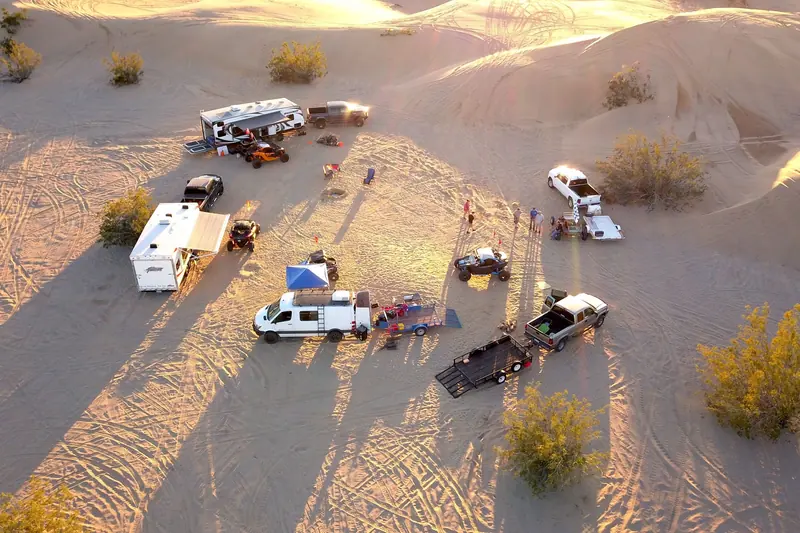
You pull into the site, turn off the engine, and look around. There is a parking pad, a picnic table, a fire ring and a lot of open ground. Where does everything go? It is easy to drop the tent in the first flat spot you see. By dark, the stove can end up a few feet from the sleeping bags, with the path to the restroom running through the guy lines.
A few minutes of planning avoids those problems. This guide covers the whole campsite: the sleeping area, the kitchen, the fire, food storage and walkways. It does not cover pitching the tent itself, which is in how to pitch a tent step by step.
The advice below comes mainly from the National Park Service (NPS) and Leave No Trace guidance, and it fits most developed campgrounds. Every park and campground has its own rules, so treat the posted rules and a ranger or host as the final word.
Walk the site before you unpack
NPS says a frontcountry site usually has a parking space, a fire ring or grill, and a picnic table. The first big decision is where to put your tent and your cooking station. NPS advises you to walk the boundaries of the site first, then pick locations for the tent, the cooking station and the eating station. Keeping a safe distance among the three makes the area safer and more comfortable.
While you walk, check for hazards. NPS names flash flooding, lightning, wind and dead trees or branches. Look up: if you see dead branches overhead, do not camp under them. Ask yourself two more questions: do you want to be near the restroom for convenience, or farther away where it is quieter and darker? Does the site suit your vehicle?
Arrival is also the time to speak to a ranger or campsite host. NPS says they can tell you about alerts, conditions and regulations that may affect your trip.
A simple map of zones
| Zone | Where it goes | Why |
|---|---|---|
| Sleeping | Level ground, not a low spot, a safe distance from the fire ring | NPS: sparks can melt or ignite a tent, and low ground gets very wet in rain |
| Kitchen and eating | At the picnic table, apart from the tent | NPS says to keep the tent, cooking and eating areas separate |
| Fire | In the existing fire ring only | NPS says to keep tents, gear and flammable items at least 15 feet (4.6 m) away and upwind |
| Food storage | In the locker, box or vehicle the park allows | NPS says to secure food, garbage and scented items right after arrival |
| Walkways | Open lanes to the table, restroom and car | NPS says stakes and lines near high-traffic areas become tripping hazards |
| Trash | One closed bag, emptied at the dumpster each night | NPS asks frontcountry campers to use the dumpster nightly |
Smokey Bear gives a similar number for fires: stay at least 15 feet (4.6 m) from tents, vegetation and low-hanging branches. Keep extra firewood stacked upwind of the fire too, as NPS advises. Rules for building fires are in campfire rules and fire restrictions.
Use durable surfaces and stay in your site
Leave No Trace guidance, as NPS states it, calls durable surfaces maintained trails and designated campsites, rock, gravel, sand, dry grasses or snow. Its core advice is short: good campsites are found, not made. Keep the camp small, concentrate activity where plants are already gone, and do not make a new spot.
At a developed campground, your site is the durable surface. Stay inside it. NPS says not to set up parts of your campsite that encroach on a neighbor’s site, and not to pass through an occupied site without permission. NPS notes that you may be able to move the picnic table around a bit, so use that freedom before you move the ground.
If you camp where there are no marked sites, Leave No Trace guidance says to camp at least 200 feet (61 m) from lakes and streams. NPS also says to choose a spot that is sheltered, away from the middle of a field if lightning is possible, away from cliff edges, away from dead trees that might fall, and away from ravines that could flood. See dispersed camping on BLM land for how this works on public land.
Food and bear country
Keep all food stored away from rodents and other wildlife, says NPS. Some campgrounds require food to go in special storage boxes. In some parks, food may stay in a car if it is out of sight, with the windows closed, and only in daylight. In others, all food must go in a locker. The rule changes by park, so read the campground page. See camping food storage.
For bear country, NPS gives distances on its campsite page: keep 200 feet (61 m) between a cooking space and a sleeping space, and store food at least 200 feet from your sleeping space. Do not sleep in clothes used during cooking. Distances in NPS materials differ between pages and parks, so ask a ranger which rule applies to your site. More in wildlife at the campsite.
A setup order that works
- Park, then walk the whole site with everyone, including kids.
- Look up, look down, and note any low spots, roots or slopes.
- Choose the tent spot first and pitch it while there is light.
- Put the kitchen at the picnic table, a distance from the tent.
- Secure food, garbage and scented items right away.
- Check the fire ring: tents, gear and flammable items at least 15 feet (4.6 m) away and upwind.
- Move chairs and lines out of walking lanes.
- Walk the site once more at dusk and fix what is in the way.
A two-night trip for two adults and one child. The tent sits on the flat side of the site, away from the road and uphill of the low spot. The picnic table and stove are on the opposite side, and the food box is by the car. The tent sits more than 15 feet (4.6 m) from the fire ring and upwind of it. Chairs go near the ring. Lines run toward the back, away from the path to the restroom.
For help reading the campground layout before you arrive, see how to read a campground map.
Common mistakes
- Pitching first, thinking later. Walk the site first.
- Putting the kitchen next to the tent. Smells and sparks follow.
- Cutting a new path. Use existing ones and the road.
- Leaving food in the open. Secure it right after you arrive.
- Ignoring the neighbors. Keep your gear on your side. Quiet hours are in quiet hours and campground respect.
- Setting up in a low spot. NPS says to avoid ravines that could flood.
Frequently asked questions
Where should the tent go on a campsite?
On level ground that is not a low spot, a safe distance from the fire ring and cooking area, and away from high-traffic lanes. Look up first for dead branches.
How far should the tent be from the fire?
NPS says tents, gear and flammable objects should be at least 15 feet (4.6 m) away and upwind of the fire pit. Smokey Bear gives the same distance.
Can you move the picnic table?
NPS says you may be able to move it around a bit. Do not drag it across plants, and put it back at check-out.
What if the site is smaller than you expected?
Use the space in zones: sleeping on one side, kitchen on the other. If it truly does not fit your group, ask the host about another site.
Next step: build your checklist
Print or open the Planner, choose your trip type, and pack for the zones above. Then walk your next campsite with this list in hand.
Sources
Official pages used for this guide. Rules vary by place and change often, so check the page for your campground before you go.
- Finding and Setting Up a Campsite, National Park Service. Accessed November 6, 2026.
- Frontcountry Camping, National Park Service. Accessed November 6, 2026.
- Campfires, National Park Service. Accessed November 6, 2026.
- Smokey Bear: Campfire Safety, USDA Forest Service. Accessed November 6, 2026.
- Leave No Trace: The Seven Principles, National Park Service. Accessed November 6, 2026.
- Bear Safety: Storing Food, National Park Service. Accessed November 6, 2026.
- Camp Etiquette, National Park Service. Accessed November 6, 2026.
- Upon Arrival (camp safety), National Park Service. Accessed November 6, 2026.
Keep reading
Gear and Camp Setup
How to Pack for Camping: Car and Backpack Organization
Pack by job and order of use: a bin system for the car, a loaded test for the backpack, and a plan for food and trash.
Gear and Camp Setup
How to Clean, Dry and Store Camping Gear
Unpack, dry, clean, inspect and store your gear after each trip so it stays fresh and ready for the next one.
Gear and Camp Setup
Tent Types Explained: How to Choose Shelter for Camping
Dome, tunnel, cabin and A-frame tents compared, with simple rules for matching a tent to your trip.